Author: Ufuk Yilmaz

Bruker Excellence Award at the EUCMOS2025

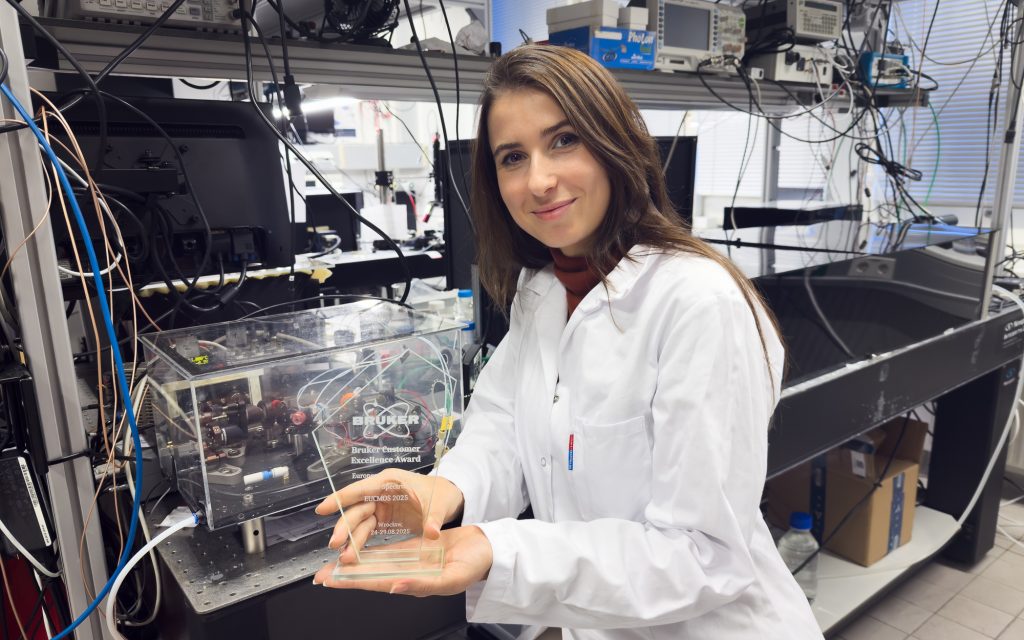
We’re very happy to share that Dr. Alicja Dabrowska received the Bruker Excellence Award for her presentation “Mid-IR complex refractive index sensing: towards integrated MZI platform” at EUCMOS 2025 in Wrocław, Poland.

What made this recognition even more meaningful is that the conference was held in her hometown, making the moment extra special!

A well-deserved award and a great acknowledgment of her work on advancing mid-IR dispersion spectroscopy for liquid analysis and translating it into integrated photonic sensing platforms – a key part of our efforts and contribution to the M3NIR EU project.

Please join us in celebrating this achievement – and stay tuned for where her research leads next! 🚀
Welcome Gabriel & Sebin

We welcome two new international PhD students to our research group: Gabriel and Sebin.

They will conduct their thesis as part of the PROTEMICS project, which is an Marie Skłodowska-Curie Actions Joint Doctoral Training Network funded by the European Union’s Horizon Europe research and innovation funding programme.

Gabriel is originally from Maringá, Paraná, Brazil and earned a Bachelor of Science degree in Physics from the State University of Maringá (UEM). In 2025, he acquired the title of Master of Science in Physics from UEM by the defense of his thesis, titled “Instrumentation of the technique of thermal lens microscopy”.

Sebin, is from Kerala, India and has completed his Master’s degree in Applied Physics and holds a Bachelor’s degree in Physics from CMS College Kottayam. As part of his master’s thesis, he worked on Laser-Induced Breakdown Spectroscopy (LIBS) at Cochin University of Science and Technology. Outside academics, I enjoy drawing and photography, which I pursue as hobbies.

Welcome again, Gabriel and Sebin. Good luck on your journey and academic achievements.

Best Science-Slam Award at CDG 30-Year Celebration

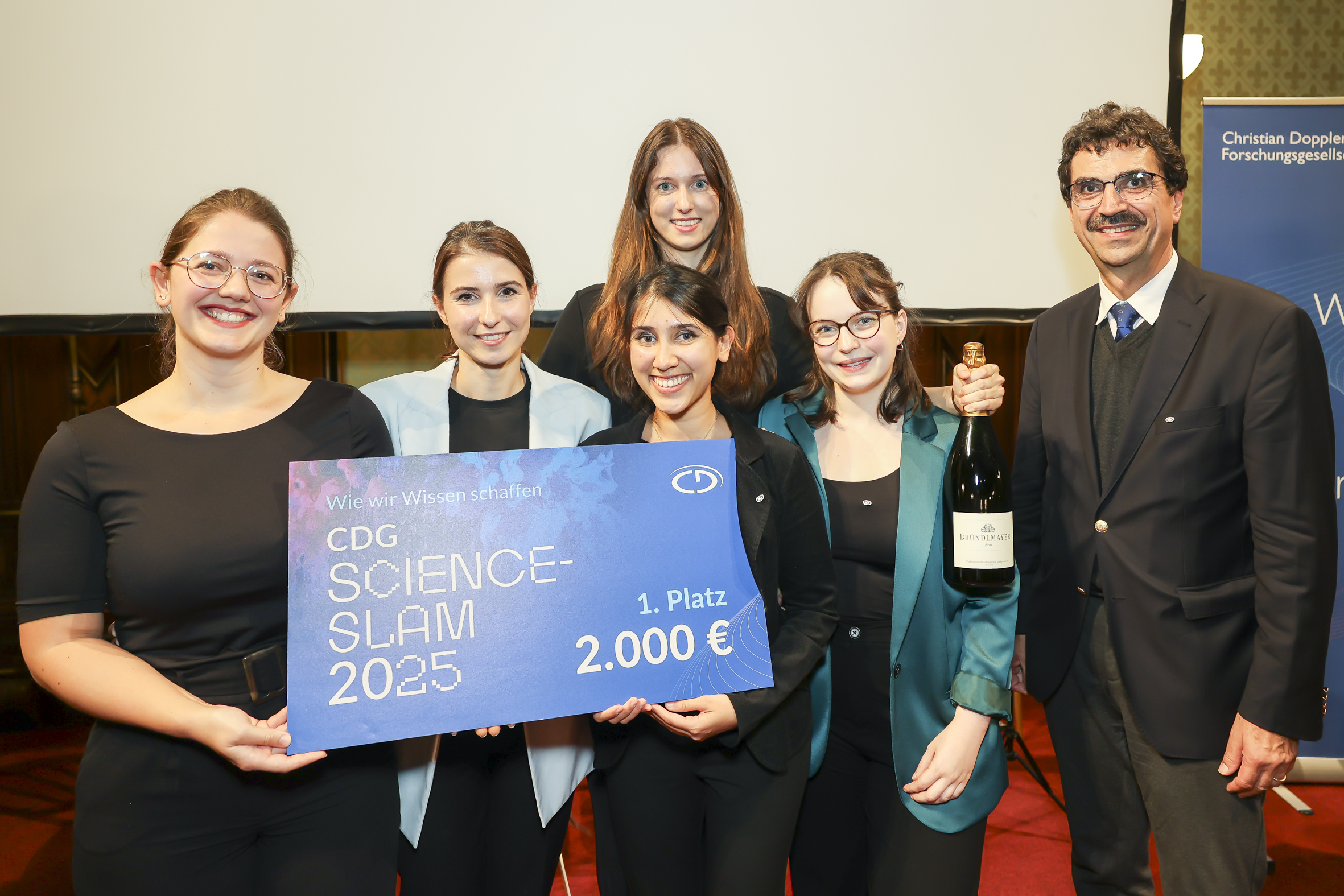
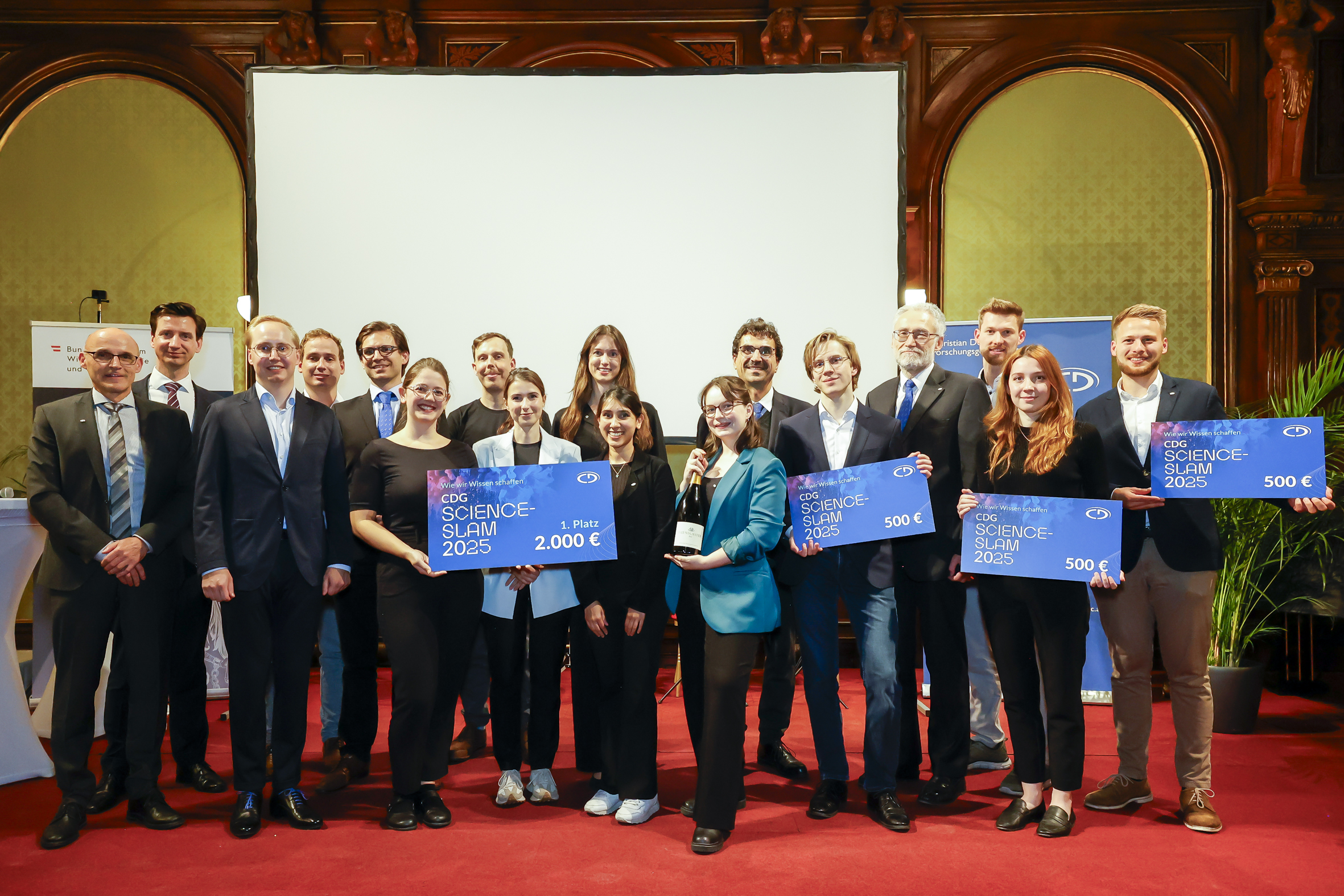
Our CD Lab team Lena Neubauer, Lisa Riedlsperger, Shilpa Vijayakumar, Verena Rohringer, Alicja Dabrowska won the Prize for Best Science Slam at the 30-Year Anniversary Celebration of the Christian Doppler Forschungsgesellschaft CDG: CDG Science-Slam

Their performance at the CDG-Science-Slam, an event organized by the Christian Doppler Forschungsgesellschaft CDG, explains in an engaging way what we do at the Christian Doppler Laboratory for Advanced Mid-Infrared Laser Spectroscopy in (Bio-)process Analytics.
This recognition comes just as our lab celebrates its first anniversary.

In only one year we have:

  • published 5 peer-reviewed papers, and
  • secured a new expansion of the laboratory with our new partner: attocube systems

With thank to all our company partners: Takeda, eralytics GmbH, Daylight Solutions and to the motivated CD lab team (Lena Neubauer, Lisa Riedlsperger, Shilpa Vijayakumar, Verena Rohringer, Alicja Dabrowska, Pily Lendl) we are looking forward to six more successful years of research, making mid-IR laser spectroscopy more performant, more sensitive and pushing to ever higher sensitivity.

New Publication in Analytical Chemistry

Check out our newest publication: https://doi.org/10.1021/acs.analchem.5c04707 (open access).

This research was led by Yide Zhang, and recently published in ACS Analytical Chemistry and combines multiple fields of expertise.

This paper introduces a detailed study on how AFM-IR can be used to image subsurface features in organic multilayer structures. The work shows that image broadening strongly depends on whether the infrared excitation occurs in the top layer or beneath it, and that the lateral size of the absorber plays a key role in signal strength and spatial resolution. These findings are backed by experiments and finite element simulations, showing excellent agreement. The study also explains how irregular sample geometries influence photothermal expansion, providing a clear origin for distinct imaging artifacts. Overall, the results advance the understanding of AFM-IR signals and point the way toward more reliable and higher-resolution nanoscale chemical imaging.

Special thanks also to our co-authors, and the supervisors Ass. Prof. Dr. Georg Ramer, Prof. Dr. Bernhard Lendl, and Dr. Liam O’Faolain for enabling the collaborative environment between TU Wien (Austria) and Munster Technological University (Ireland).

CAVS at EUROANALYSIS 2025

Big things happened in Barcelona last week — and no, we’re not talking about the tapas 🍤🍷 (They’re always excellent).

At EUROANALYSIS 2025 (31 Aug – 4 Sep) our PhD students really delivered:
Sebastian Wöhrer presented his poster: “Polarization Modulation Infrared Reflection Absorption Spectroscopy (PM-IRRAS) as a tool for investigating low-dimensional materials “and won one of the Best Poster Awards, including a €150 Wiley voucher. VAMOS!

Nikolaus Hondl gave a Young Oral Presentation on:
“Label-Free Chemical Spectroscopy of Cancer Cells: A Comparative Study of O-PTIR and FTIR Spectroscopy.”

We couldn’t be prouder. Fantastic science, well-earned recognition, and a great week in Barcelona.

New Publication in RSC Analyst

Congratulations to Felix Frank on his new paper: https://doi.org/10.1039/D4AN00861H (Open Access), with the title:

‘In situ study of the interactions between metal surfaces and cationic surfactant corrosion inhibitors by surface-enhanced Raman spectroscopy coupled with visible spectroscopy’

published in RSC Analyst.

Cationic surfactants are widely used as corrosion inhibitors for industrial tubings and pipelines, protecting them by forming a protective layer. In order to make this process more efficient, understanding their interactions is crucial. In our new paper, we shine light on the formation of inhibition layers using SERS coupled to VIS spectroscopy, using the aggregation of silver nanoparticles induced by cationic surfactants as a model system for other metal surfaces. Combining these methods with light scattering methods revealed a correlation between aggregated particles with the SERS/VIS spectra depending on the surfactant concentration. These findings could also be used to devise a method for the detection of surfactant-based corrosion inhibitors, enabling resource-efficient, continuous process control.